
The Governance Layer for Clinical Decision Support.
Implement CDS changes safely, confidently, and with speed.
The Cost of Status Quo
Alert fatigue is the status quo
Override rates above 90%. Staff tunes out. The alerts meant to protect patients become noise—but no one can prove which ones to cut safely.
CDS changes take months or years
Manual chart review, ad-hoc SQL, months of committee cycles. Implementation bottlenecks mean even obvious improvements sit in backlogs indefinitely.
Quality measures hurt your bottom line
CDS should improve outcomes. Instead, poorly governed alerts create workflow drains, efficiency losses, and malpractice exposure—while compliance scores drift.
Sepsis protocols alone can involve 50+ interacting rules across nursing, physician, and pharmacy workflows. Governance committees aren't slow because they don't know what to change. They're slow because they can't prove the change is safe.
SEP-1 Now Hits Revenue
SEP-1 entered the VBP Safety Domain in 2024 as a reported measure. Starting FY2026, it becomes a payment measure—your sepsis performance now directly affects Medicare reimbursement.
~1,200 hospitals currently score zero SEP-1 points. Fear of dropping compliance keeps noisy alerts firing—but override rates above 90% mean staff isn't listening anyway.
Health systems that can safely optimize their sepsis CDS will reduce alert noise, improve compliance, and protect revenue—without committee paralysis.
How It Works
From retrospective insight to prospective validation—with a complete audit trail.
Purpose-built for Epic BPA environments. No FHIR integration required.
See how your CDS rules actually perform: override rates, collision patterns, compliance gaps.
Surface redundant and conflicting rules across domains. Know which alerts fire together and why.
Replay proposed changes against historical patient cohorts. See the impact before anything goes live.
Version-controlled rule definitions, simulation results, approval chain, and Epic-ready build artifacts.
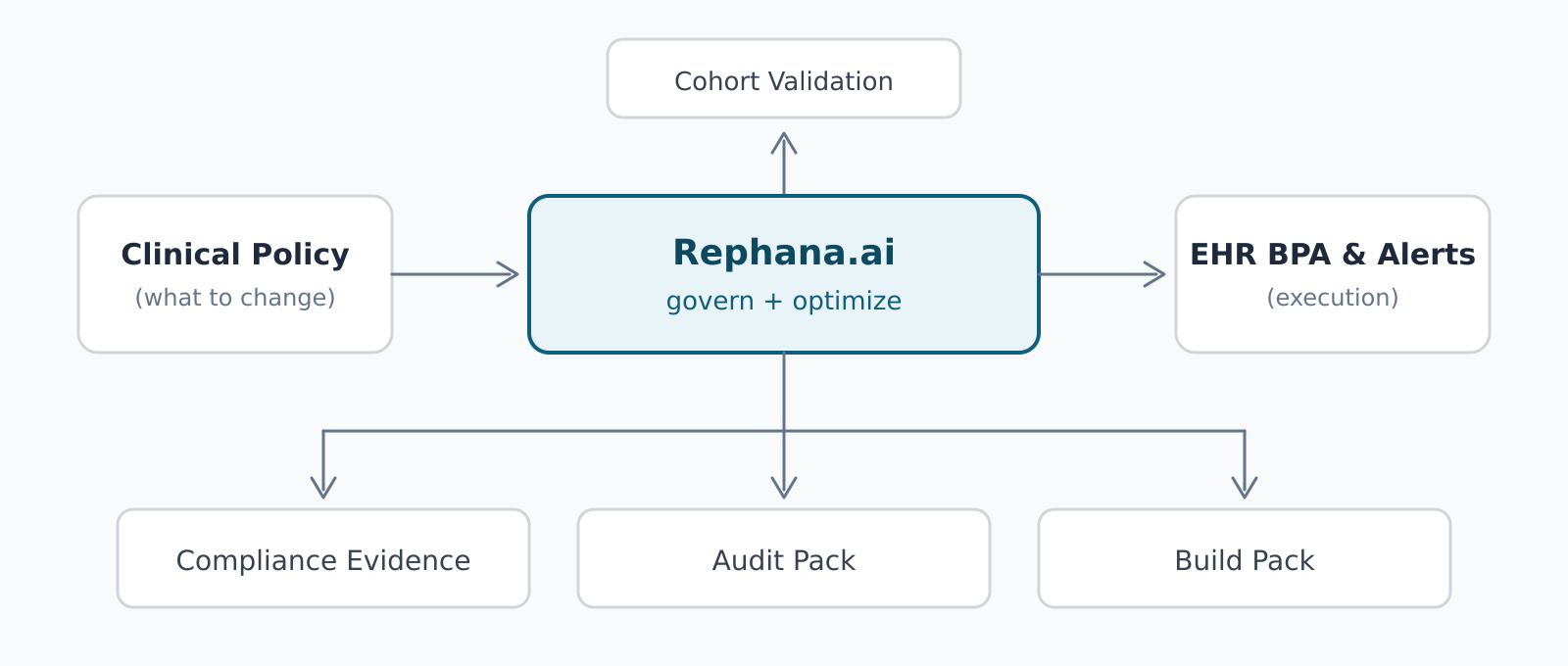
Instead of debating in committee for months, teams see the impact of proposed changes before anything ships.
See What’s Hidden in Your CDS Rules Forest
Surface collisions. Prove safety. Export implementation-ready artifacts.
Alert Override Analysis
INSIGHTSAcross 4 high-volume units
Collision Families
6 clusters detectedSEP-1 Risk Audit
COUNTERFACTUAL ANALYSISCohort Safety & Compliance Validation
SIMULATIONAgainst proposed policy change
About
Rephana.ai is building governance infrastructure for clinical decision support systems. Health systems run hundreds of CDS rules across sepsis, VTE, opioids, falls, and more - with no systematic way to assess the risk of changing any of them. The result: committees that freeze, alert noise that compounds, compliance exposure that grows silently, and clinicians who absorb the cost. EHRs provide build environments. Reporting platforms show what already failed. Neither solves the core problem: proving that a proposed change is safe, auditable, and defensible before it reaches production. Rephana.ai provides the infrastructure layer that makes CDS changes defensible. Currently in stealth and engaging selectively with health system leaders and strategic partners.
Connect on LinkedIn →Request early access
We're speaking selectively with CMIOs, CNIOs, VP Quality leaders, Clinical Informatics Directors, and Nursing Informatics Directors at Epic-based health systems—plus strategic partners and long-term investors.